
The Corporate Playbook That Worked in Toronto Didn’t Work in Bangkok

4 min read

The Corporate Playbook That Worked in Toronto Didn’t Work in Bangkok

Early in my career, a mentor in Toronto gave me advice that seemed perfectly sound at the time: “A good deal is a good deal anywhere in the world. Just get the numbers right and the rest follows.”

I understood the logic. In the financial world I was being trained in, rigor was rigor and the model was the model. Numbers were supposed to be the universal language — clean, portable, culture-neutral.

Three decades of leading teams across eight markets taught me something very different.

In much of the West, relationships often emerge from successful transactions. Across much of Asia, successful transactions often emerge from relationships. If you don’t understand that shift — not as a cultural footnote, but as a fundamental business reality — even the most sophisticated financial model in the world may not save your deal.

Let me be clear about something first. I have learned a tremendous amount from Western leadership culture: accountability, directness, the discipline to challenge assumptions, the willingness to execute decisively even when things are uncomfortable. Those strengths matter enormously, and I have tried to carry them with me across every market I have worked in.

But one of the most consistent mistakes I watched global leaders make — and that I made myself in the early years — was assuming that what worked exceptionally well at home could be carried across time zones and applied without adjustment to a different room, a different culture, and a very different set of unwritten rules.

I watched this play out many times during my years with multinational banks. Senior executives would arrive in a regional market, take command of the boardroom, deliver an impressive presentation, and walk away convinced they had achieved alignment. The local team had listened carefully, nodded at the right moments, and asked very few difficult questions. The visitors often left feeling that things had gone well.

But silence is not always agreement. Sometimes it is respect. Sometimes it is caution. Sometimes it is simply good manners. And sometimes — in my experience — it is all three at once.

I still remember a CFO in Hanoi pulling me aside after one particularly energetic meeting. He smiled politely and said, without any apparent frustration: “Your colleague talks too much.”

The deal, unsurprisingly, went nowhere.

Over the years I came to understand that succeeding across cultures had far less to do with intelligence and far more to do with observation — specifically, the willingness to slow down and pay attention to the room you were actually in, rather than the room you expected to be in.

Three things became clear to me, not as rules I was taught but as lessons I learned by getting them wrong.

The first is that silence rarely means what Western leaders assume it means. In many parts of Asia, open disagreement — particularly with a senior visitor — is not the instinctive response. People reflect differently, preserve harmony differently, and communicate hesitation differently. Walking out of a meeting convinced you have secured commitment when you have only secured quiet is a very common and very costly mistake.

The second is that relationships are not a by-product of the transaction. In many markets across Asia, trust is not something you build after the deal is signed. It is the precondition for the deal ever being taken seriously. Showing up with a compelling pitch before you have invested in the relationship — before the other side has had the chance to understand who you are and what you stand for — can close doors before you even realize they were open.

The third lesson I learned in Bangkok, and it has stayed with me the longest.

When I stepped into my first significant leadership role in the city, I inherited a senior leader who had openly aspired to the very position I had just been given. The more conventional corporate response might have been to gradually manage him out — reduce his scope quietly, signal that the transition had been decided, and let time do the rest.

I sensed that was the wrong approach. If he lost face publicly, I wasn’t simply managing a difficult personality. I was risking the confidence of the entire team and the culture I was trying to build. In that context, how I treated him was a signal about how I would treat everyone.

I expanded his responsibilities instead. I built a more visible platform around him and positioned him as a critical leader within the organization. It was not simply a calculation about one individual. It was a decision about trust — about what kind of leader I intended to be in that room.

Over time, I earned not only his loyalty but the confidence of the broader team. That outcome did not come from any framework I had studied. It came from understanding that protecting dignity, in many parts of Asia, is not a soft leadership consideration. It is one of the most strategic moves available to you.

As the economic center of gravity continues shifting toward Asia, I think cross-cultural intelligence can no longer be treated as a sensitivity that thoughtful leaders carry as a secondary skill. For leaders operating across borders, it may be one of the most important strategic capabilities they can develop.

The goal is not to abandon the leadership instincts that have served you well. It is to hold them more lightly — and to stay curious enough about the room you are actually in to understand what it requires of you.

Because the next time you step into a boardroom in Bangkok, Hanoi, or anywhere outside your own cultural comfort zone, the most valuable thing you may be able to do is slow down, listen carefully, and pay close attention to what is not being said.

In many parts of the world, the relationship is not separate from the deal.

It is the deal.
Insights Worth Exploring

Decision-Making

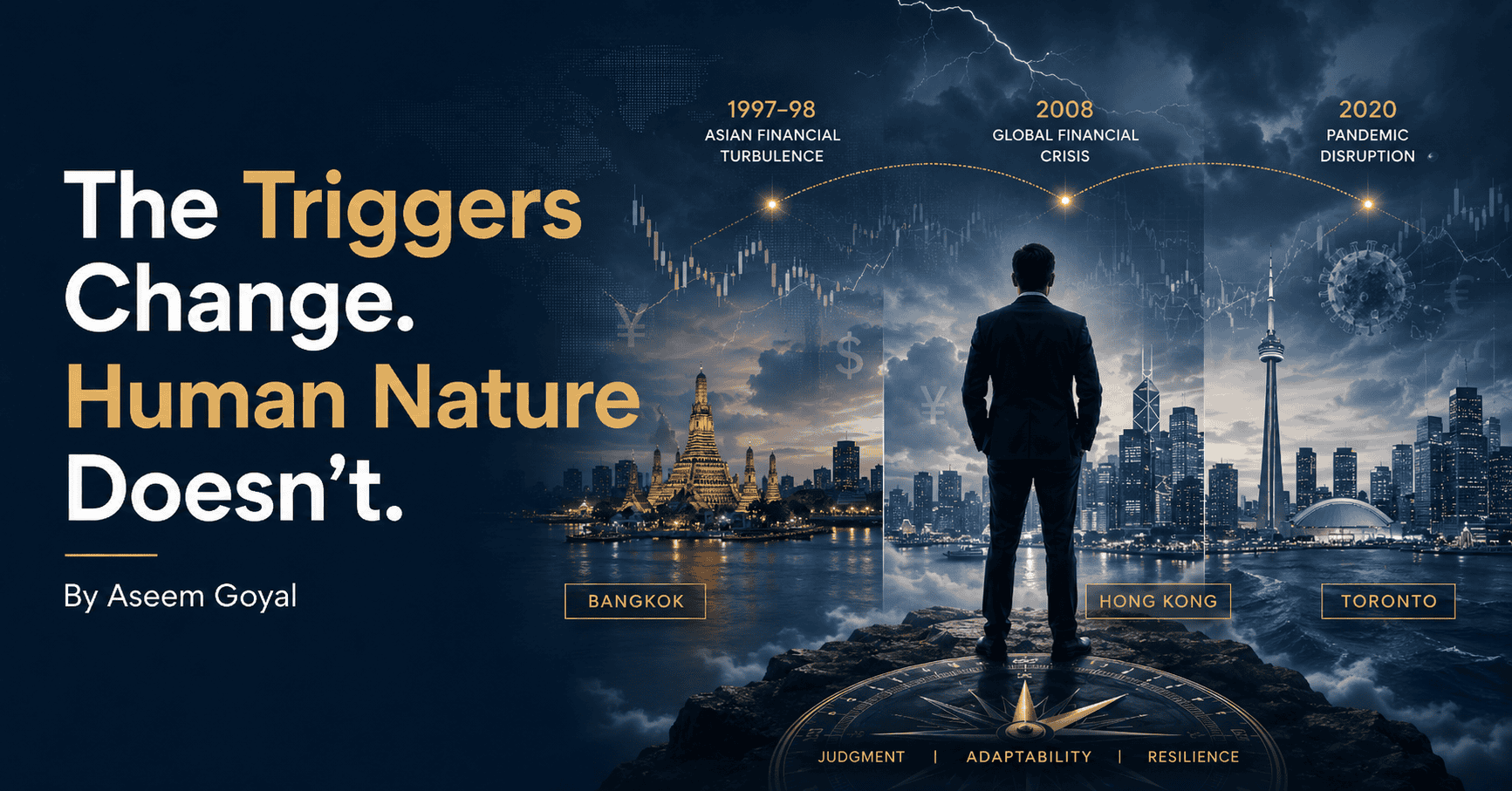
The Triggers Change. Human Nature Doesn’t.

In July 1997, the Thai baht was allowed to float. The operating assumption that had underpinned years of lending decisions, client conversations, and regional growth strategies was gone overnight.

I was in Bangkok at the time, managing a European multinational portfolio, and within weeks I was on a plane to Europe — Paris, Munich, Zurich, London — to sit across from clients and headquarters teams who were trying to make sense of what had just happened. I did not go with solutions. There were no solutions yet. I went with facts, with a calm voice, and with the willingness to stay in difficult conversations rather than retreat to reassuring language that no one believed.

What surprised me — and has stayed with me ever since — was that the panic at headquarters in Europe was, in many ways, as acute as the panic in Bangkok. Distance did not provide perspective. If anything, it amplified the uncertainty. The people closest to the situation were the ones doing the most steady thinking. The people furthest from it were often the most frightened.

That observation planted something in me that I have returned to many times since.

I have lived through three global crises in my career. Each had a different origin, a different headline, and a very different shape. The 1997 Asian Financial Crisis was a story of currency pressure, leverage, and the speed with which regional contagion spreads once confidence breaks. The Global Financial Crisis of 2008 was built on decades of financial excess and the systemic fragility those excesses created. COVID-19 was something else entirely — not a market failure but a human emergency that stopped the world in a way that no financial model had ever tried to capture.

The triggers were different. The headlines were different. The instruments of disruption were different.

But the underlying pattern felt surprisingly familiar every time.

In 1997, I watched sophisticated institutions discover that their assumptions had been more fragile than they appeared. In 2008, I experienced that directly. I had moved to what I believed would be a defining role as Senior Managing Director in Hong Kong. Within twenty-four hours of starting, I found myself without a job. The Global Financial Crisis had moved faster than any of us had fully anticipated, and the floor I thought I was standing on was no lower onger there. Three months followed that were among the most disorienting of my career — a period of genuine uncertainty about what came next, and a private reckoning about what I had placed too much faith in.

Then came 2020. Unlike the previous crises, this one was not initially about markets or balance sheets.

It was about life.

After more than two decades in banking across Asia, my family and I had made the decision to return to Canada. I had secured a role on Bay Street in Toronto, bringing my career full circle to where it had all begun. Because of the school year, we decided that I would go ahead first and the family would follow three months later.

On March 5, 2020, I boarded a plane alone. I started my new role on March 9. Within days, the world changed. COVID-19 was spreading rapidly. Offices shut down. Streets emptied. Uncertainty took hold.

Despite joining a new organization, I never truly arrived. I never went to the office. I never met a colleague in person. I never shook a single hand.

The bustling Toronto I remembered from earlier chapters of my life had become eerily quiet. What should have been an exciting new beginning became five months of isolation, thousands of miles away from my family. For the first time in my career, success and fulfillment no longer seemed to be asking the same question.

Eventually, I made a decision. I resigned and returned to Thailand. On paper, it may have looked like a step backwards. In reality, it was a step toward what mattered most.

That experience became another form of reinvention. Over the following years, I invested in myself in ways I had never previously imagined. I completed executive studies at MIT Sloan, became an ICF-certified Global Leadership Coach, joined multiple Advisory Boards, and began building a new chapter beyond traditional corporate banking.

COVID taught me something that neither 1997 nor 2008 had fully revealed. Sometimes resilience is not about holding on. Sometimes it is about having the courage to change direction.

Three crises. Three very different circumstances. And each time, beneath the specific trigger and the specific market disruption, the same human dynamics at work: the initial disbelief that this is actually happening, the scramble for information in the absence of reliable data, the gradual recognition that the old playbook no longer applies, and finally — if you are fortunate and disciplined — the slow, difficult work of adaptation.

We convince ourselves, before these moments arrive, that disruption of this magnitude happens somewhere else. To other markets, other institutions, other leaders. We build frameworks that give us the feeling of preparedness. And then something breaks through those frameworks, and the real work begins.

What I have come to believe — not as a theory but as something I have lived — is that leadership in genuinely uncertain times is not primarily about prediction. Markets will always carry risks that are invisible until they are not. The most dangerous assumption a leader can make is that certainty is the natural state of things, and that uncertainty is the exception to be managed rather than the condition to be expected.

What actually matters, in those moments, is judgment. The ability to stay grounded in fundamentals when the noise is loudest. The willingness to communicate honestly, even when honesty means saying “I don’t know yet, but here is what we do know.” The capacity to adapt quickly without losing sight of the values that define how you lead.

And perhaps the most counterintuitive thing I have learned across these three experiences: certainty itself can sometimes be the biggest risk of all. The leaders I watched navigate these periods well were rarely the most confident ones in the room. They were the ones most willing to hold what they didn’t know alongside what they did — and to keep moving forward without waiting for the uncertainty to resolve itself first.

When there is no map, leadership relies on a compass.

That is not a metaphor I use lightly. It is, as best I can describe it, what I have actually needed in the moments that mattered most.

Most of us, I suspect, carry at least one crisis that changed how we lead — a moment when the assumptions broke and something more durable had to take their place. I would be curious whether others have found the same pattern: that the trigger changes each time, but what it demands of us as leaders remains, in the end, remarkably consistent.

In July 1997, the Thai baht was allowed to float. The operating assumption that had underpinned years of lending decisions, client conversations, and regional growth strategies was gone overnight. I was in Bangkok at the time, managing a European multinational portfolio, and within weeks I was on a plane to Europe — Paris, Munich, Zurich, […]

4 min read
Change and Disruption, Executive Leadership

The Layoff Is Not the Hardest Part. The Conversation Is.

When news broke that Meta employees had learned about their layoffs through emails arriving overnight, it sparked a familiar and uncomfortable debate. But Meta is not the first company to handle a reduction this way, and they will not be the last.

Over the years, we have watched technology companies and traditional corporations alike rely on mass emails, sudden system lockouts, and carefully sequenced automated exits. To be fair, there are practical reasons for this. Large organizations move at speed. Legal risk is real. Consistency matters. When you are letting go of hundreds or thousands of people simultaneously, the logistics alone are genuinely staggering.

But after more than three decades of leading teams across eight markets, I have come to believe something uncomfortable: the hardest part of a layoff is not the decision. It is sitting across from another human being and having the conversation.

No management program I have encountered prepares you for that moment. No leadership framework tells you what it actually feels like to look someone in the eye and know that the next ten minutes will fundamentally disrupt their life.

I still carry the memory of those rooms.

The first person I think of is someone I worked with closely for six months on a performance improvement plan. We had built something real together — honest conversations, incremental progress, a shared belief that things were moving in the right direction. When the outcome became inevitable, she asked for three additional months — not for her pride, but because of significant financial pressure at home. I fought the organization to get it for her. I am not certain everyone above me agreed. But I knew that what mattered in that room, at that moment, was not the policy. It was the person.

The second was a close colleague — someone I genuinely respected. Managing that conversation required a different kind of discipline: the conscious effort to overcorrect for the friendship, to ensure that my decision was entirely objective and that no one watching could ever suggest the relationship had shielded him from a fair outcome. Friendship and fairness had to coexist in the same room, and they had to be seen to coexist.

The third responded to the news by immediately threatening legal action. I remember the surge of frustration, the effort to stay composed, and the quiet reminder to myself that the reaction — however difficult to absorb in the moment — was still a human reaction to a frightening one.

Three very different people. Three very different conversations. One principle that never changed: empathy and dignity are not optional, even when the circumstances are painful or adversarial.

What I did not fully understand until I had been through enough of these moments was what they were doing to me as a leader. Those conversations changed how I led afterward, in ways I did not expect and did not plan for.

I became more transparent, not less. More aware of the anxiety that people carry behind polished and professional exteriors — the mortgage, the school fees, the family depending on the next paycheck. More deliberate about the way I communicated difficult decisions, even the ones I had not made and did not fully agree with. I had been part of a leadership team when some of those decisions were taken. I did not always agree with the direction. But I had been in the room, and I owned what came from that room.

There is another dimension to these moments that organizations frequently overlook: the audience that is not in the room.

The people who remain are watching. They are watching to see whether the values the organization talks about actually survive under pressure. They are evaluating what kind of leaders they are following. They are drawing conclusions that will shape how much of themselves they are willing to bring back the next day, the next quarter, the next year.

They may not remember the financial logic behind a restructuring. They may not remember the operational reasons or the market conditions that made it necessary. But they will remember how the people who left were treated on the way out. And that memory is often more enduring than any town hall, any leadership communication, any set of company values printed on a wall.

Some of the most trust-defining leadership moments I have witnessed had nothing to do with a board presentation or a business result. They happened in a small office, with the door closed, when a manager chose to treat someone who was leaving as though they still mattered — because they did.

Leadership is tested during periods of growth. Character is revealed during periods of reduction.

People can understand a tough corporate decision. What they struggle to forget — and what they should not be asked to simply absorb — is being made to feel disposable. The two things are not the same, and how a leader holds the distance between them is one of the most consequential choices they will ever make.

The conversation is hard. It is supposed to be hard. That difficulty is not a failure of the process.

It is a reminder that there is a human being on the other side of it.

When news broke that Meta employees had learned about their layoffs through emails arriving overnight, it sparked a familiar and uncomfortable debate. But Meta is not the first company to handle a reduction this way, and they will not be the last. Over the years, we have watched technology companies and traditional corporations alike rely […]

3 min read